Design & Crafts

Architekturmodellbauer/in EFZ

You build detailed architectural models for planners and clients
Architekturmodellbauer/in EFZ

01 · Overview

What this profession is about

You create precise scales and models from various materials for architects and construction projects

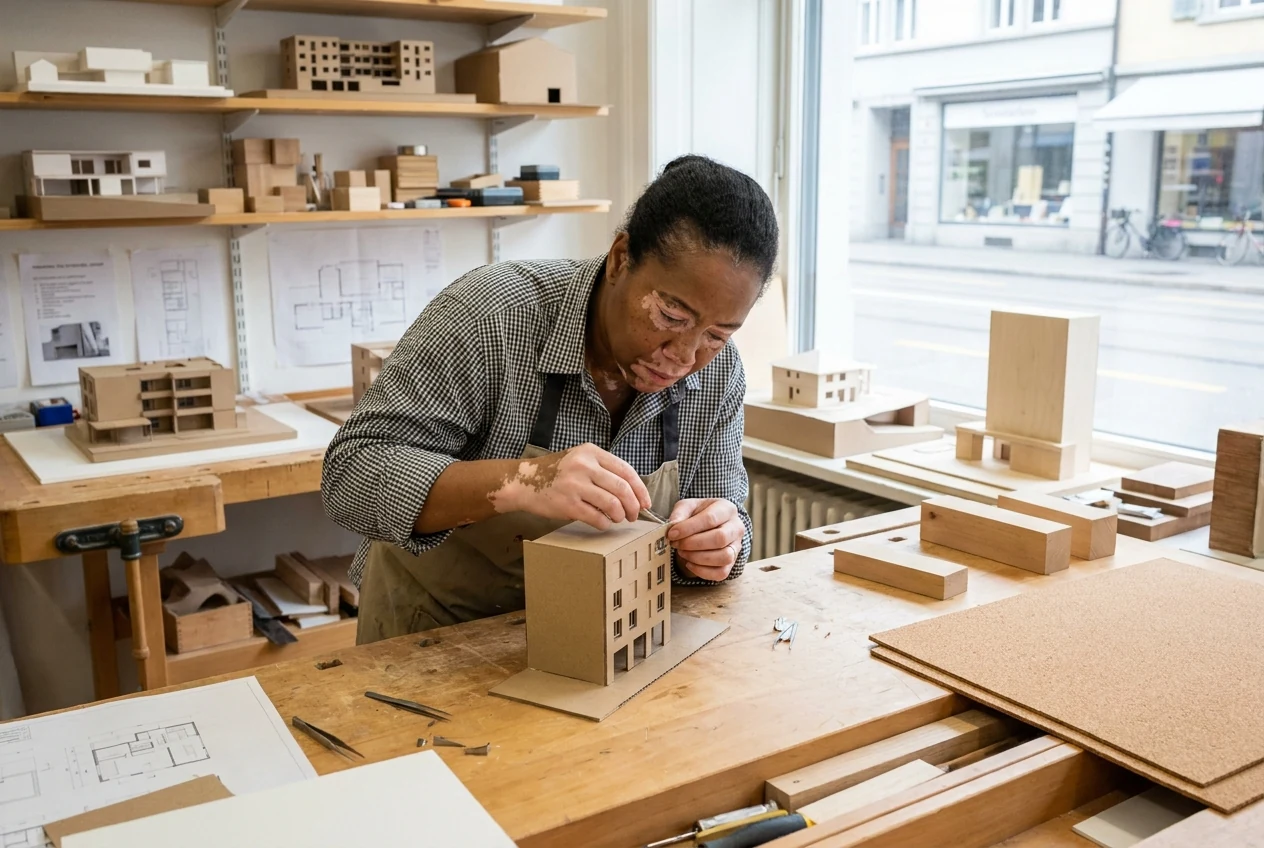
You turn technical drawings into tangible spatial concepts. In your workshop, you work with wood, cardboard, or metal with high precision. Every detail matters to make construction projects visible beforehand. With great craftsmanship and spatial imagination, you create visual designs for architects, authorities, and clients. Your work combines art with technical planning.

FieldDesign & Crafts
Education pathVocational Training (Apprenticeship)
IndustryArt & Crafts
Swissdoc 0.420.4.0

02 · Salary

What you can earn

No verified Swiss salary data is available for this profession yet.
Salaries reflect Swiss market data. Range covers entry to senior. Salary reference based on Architekturmodellbauer/in EFZ.

Salary by experience

50k60k51k48k66k0-2 yrs3-5 yrs6-8 yrs
View as table
ExperienceSalary (CHF)
0-2 yrsCHF 51'282
3-5 yrsCHF 48'480
6-8 yrsCHF 66'000

Salary trend

-18% over decade
55k60k65k66k54k2017-20192023-2025
View as table
PeriodSalary (CHF)
2017-2019CHF 66'000
2023-2025CHF 54'084

03 · Pathway

How to enter and grow

  • 🎓 Architekturmodellbauer/in EFZ
  • 4 Jahre

Official education path

The training takes 4 years in a company with 1 day of vocational school per week.

Typical training path

Architekturmodellbauer/in EFZ

Curriculum

  • Planen der Aufträge und Organisieren der Arbeiten Entwerfen und Gestalten von Architekturmodellen

Prerequisites

  • obligatorische Schule abgeschlossen

Requirements

  • good fine motor skills
  • handwerkliches Geschick
  • spatial imagination
  • drawing talent
  • sense of shapes and colours
  • precise working style
  • endurance and patience
  1. 1Planen der Aufträge und Organisieren der Arbeiten Entwerfen und Gestalten von Architekturmodellen

Where this can lead

Career changes are possible if you have related professional experience or further training certificates.

04 · Skills & fit

What it takes

Required skills

  • Fine motor skills
  • Spatial thinking
  • Craftsmanship
  • Sense of colour
  • Accuracy

Personality fit

  • Swiss career path
  • Career transition
  • Professional growth

05 · Daily reality

What the work feels like

Typical day

You stand at your workbench and cut wooden strips precisely according to a work plan. Later, you use a brush and spray gun to give the raw model its final colour and texture.

  • You create detailed drawings and work plans from blueprints for the replica.
  • You choose suitable materials like wood, metal, or cardboard for the project.
  • You estimate the time required precisely and calculate the costs for implementation.
  • You process the material with hand tools or machines like a fine band saw.
  • You glue, screw, or solder the individual parts into a sturdy frame.
  • You cover raw models with filler and sprinkle natural materials for realistic surfaces.
  • You colour the models with a brush or spray gun and set them up professionally.

Working conditions

You usually work alone or in small teams in independent workshops. The demand for architectural model-making businesses is low and depends heavily on the order situation in the construction industry.

Strengths

  • Fine motor skills
  • Spatial thinking
  • Craftsmanship
  • Sense of colour
  • Accuracy

Trade-offs

  • Deadline pressure
  • Market conditions
  • Shortage of training places
  • Physical strain

06 · Similar

You might also explore

All in Design & Crafts