Healthcare

Orthoptist/in HF

You analyse and train the eye movements of patients.
Orthoptist/in HF

01 · Overview

What this profession is about

You examine visual disorders, plan therapies and train eye muscles in clinics and private practices.

As Orthoptist/in HF, you focus on preventing and treating visual disorders. You analyse eye movements, make diagnoses and plan individual therapies. You work closely with eye doctors to train eye muscles and support patients on their way to better vision. You carry out vision tests and write precise reports for further medical care.

FieldHealthcare
Education pathContinuing Education Profession
IndustryMedical Technology
Swissdoc 0.723.47.0

02 · Salary

What you can earn

MedianCHF 70'000
CHF 40'000CHF 98'000
✓ Exact salary match
Salaries reflect Swiss market data. Range covers entry to senior. Salary reference based on Orthoptiste. Based on 12 observations, updated 7 months ago.

Salary by experience

50k100kmedian 70k60k60k24k81k97k0-2 yrs3-5 yrs6-8 yrs12-21 yrs21+ yrs
View as table
ExperienceSalary (CHF)
0-2 yrsCHF 60'000
3-5 yrsCHF 60'000
6-8 yrsCHF 24'000
12-21 yrsCHF 81'250
21+ yrsCHF 97'000

Salary trend

+92% over decade
60k80k50k60k55k96k2014-20162017-20192020-20222023-2025
View as table
PeriodSalary (CHF)
2014-2016CHF 50'000
2017-2019CHF 60'000
2020-2022CHF 55'000
2023-2025CHF 96'000

Top paying industries

  • Health care / Social servicesCHF 80'62510 obs.
View as table
IndustrySalaryObs.
Health care / Social servicesCHF 80'62510

03 · Pathway

How to enter and grow

Swiss training pathway available in the full profile

  • 🎓 Dipl. Orthoptist/in HF
  • 3 Jahre, Vollzeit

Official education path

The training lasts three years full-time and leads to a diploma as Orthoptist/in HF.

Typical training path

Dipl. Orthoptist/in HF

Prerequisites

  • eidg. Fähigkeitszeugnis (EFZ)
  • Fachmittelschulausweis
  • Berufs-, Fach- oder gymnasiale Maturität or equivalent qualification
  • passed aptitude assessment

Requirements

  • strong observation skills
  • sense of responsibility
  • sociability and communication skills
  • manual and technical dexterity

Where this can lead

A lateral entry is possible after a related initial qualification or through recognised further training. The schools check whether previous qualifications can be credited.

04 · Skills & fit

What it takes

Required skills

  • Observation skills
  • Communication skills
  • Sense of responsibility
  • Manual dexterity

Personality fit

  • Swiss career path
  • Career transition
  • Professional growth

05 · Daily reality

What the work feels like

Typical day

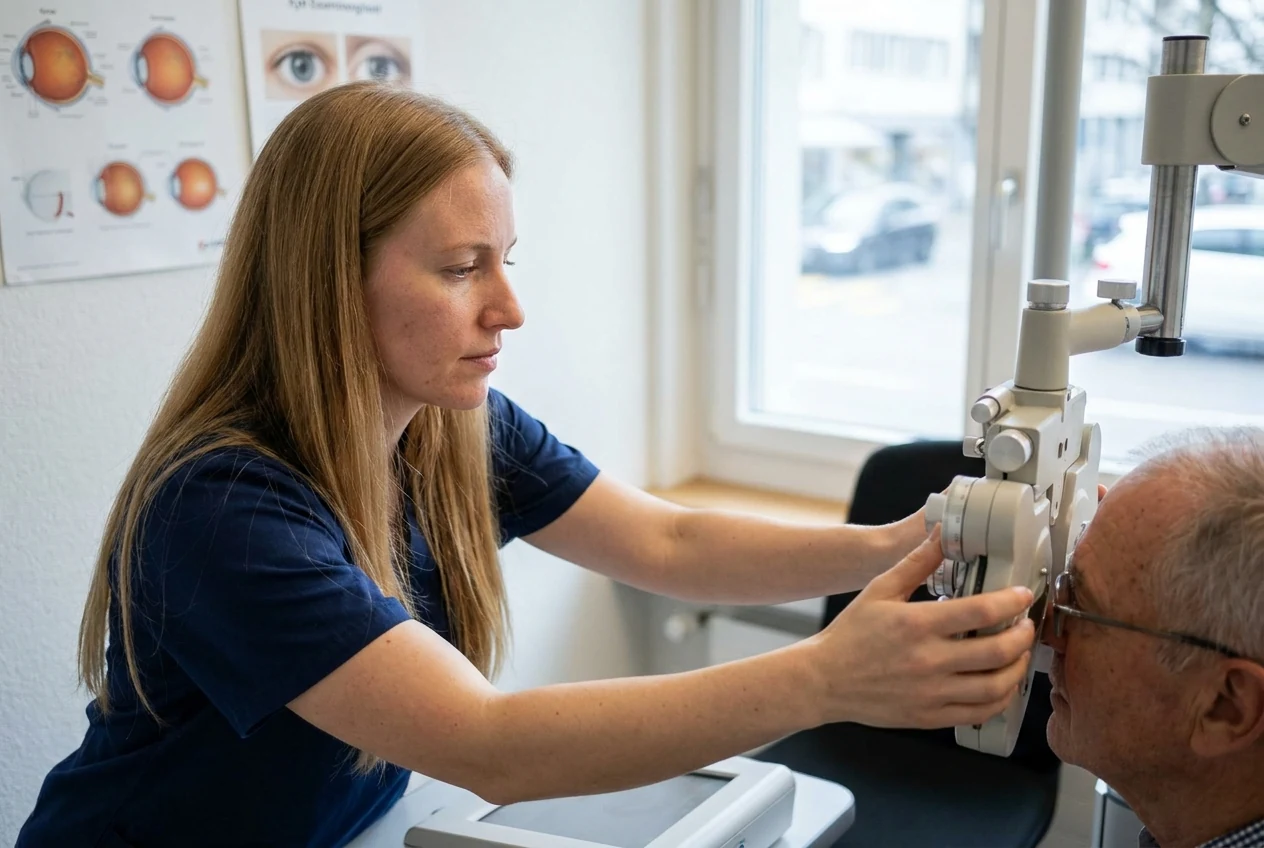
You stand at the examination table and adjust the optical devices precisely while the patient focuses on the given stimuli. You then discuss the measured values and give the first instructions for training at home.

  • You examine eye alignment and measure visual acuity.
  • You analyse eye movements and check how both eyes work together.
  • You ask in detail about symptoms like headaches or blurred vision.
  • You make a well-founded diagnosis based on the findings.
  • You plan individual therapy programmes together with specialists.
  • You carry out orthoptic exercises to strengthen the eye muscles.
  • You instruct patients to repeat the exercises independently at home.
  • You assist with eye surgeries if needed.
  • You carry out vision tests in kindergartens and schools.
  • You maintain patient records and write orthoptic reports.

Working conditions

You work in eye clinics, private eye practices, facilities for the visually impaired or in school health services. You often work under the direction of eye specialists, but you have a high degree of professional autonomy.

Strengths

  • Observation skills
  • Communication skills
  • Sense of responsibility
  • Manual dexterity

Trade-offs

  • Physical strain
  • Emotional demands
  • Documentation effort
  • Continuing education requirement

06 · Similar

You might also explore

All in Healthcare