Education & Social Work

Reitpädagoge/-pädagogin

Reitpädagoge/-pädagogin promote people holistically through work with horses.
Reitpädagoge/-pädagogin

01 · Overview

What this profession is about

You use horse-assisted therapy to support clients with psychological, physical, and social challenges.

Working with horses opens doors where words alone fall short. As Reitpädagoge/-pädagogin, you guide people on their path to greater self-confidence and physical balance. You assess support needs. You plan individual therapy sessions. You build a trusting relationship between humans and animals. The focus is not on riding. It is on the holistic development of your clients.

FieldEducation & Social Work
Education pathSpecialisation / Professional Function
IndustryAccompaniment & Support
Swissdoc 0.731.29.0

02 · Salary

What you can earn

No verified Swiss salary data is available for this profession yet.
Salaries reflect Swiss market data. Range covers entry to senior. Salary reference based on Reitpädagoge/-pädagogin.

Salary by experience

40k60k80k40k81k29k64k36k0-2 yrs6-8 yrs9-11 yrs12-21 yrs21+ yrs
View as table
ExperienceSalary (CHF)
0-2 yrsCHF 40'000
6-8 yrsCHF 81'447
9-11 yrsCHF 29'324
12-21 yrsCHF 64'000
21+ yrsCHF 36'000

Salary trend

+251% over decade
50k100k28k47k98k2017-20192020-20222023-2025
View as table
PeriodSalary (CHF)
2017-2019CHF 28'000
2020-2022CHF 46'969
2023-2025CHF 98'280

03 · Pathway

How to enter and grow

Swiss training pathway available in the full profile

  • 🎓 Reitpädagoge/-pädagogin SG-TR bzw. DAS HES-SO in pferdegestützter Therapie
  • SG-TR: 1 bis 2 Jahre berufsbegleitend PI-CH: 3½ Jahre berufsbegleitend

Official education path

The training is part-time and provided by recognised associations. It lasts between 1 year and 3½ years.

Typical training path

Reitpädagoge/-pädagogin SG-TR bzw. DAS HES-SO in pferdegestützter Therapie

Prerequisites

  • SG-TR: Completion of a basic qualification in pedagogy, social work, or health
  • SG-TR: Minimum 1 year of professional experience
  • SG-TR: Equestrian qualification (Reiterbrevet II SVPS or equivalent)
  • SG-TR: Several years of experience working with horses
  • PI-CH: Minimum age 25 years
  • PI-CH: Completed basic training at university of applied sciences or higher specialist school level in pedagogy, social pedagogy, or health
  • PI-CH: Minimum 2 years of professional practice
  • PI-CH: Equestrian qualification (Reiterbrevet II SVPS or equivalent)
  • PI-CH: Several years of experience working with horses
  • PI-CH: Attendance at an information event
  • PI-CH: Admission test with a personal interview

Where this can lead

Career changers can enter the field if they already have a basic qualification in pedagogy, social pedagogy, or health. Associations and universities of applied sciences offer targeted further education courses to complement this.

04 · Skills & fit

What it takes

Required skills

  • Observational precision
  • Empathetic attitude
  • Horse expertise
  • Planning skills

Personality fit

  • Swiss career path
  • Career transition
  • Professional growth

05 · Daily reality

What the work feels like

Typical day

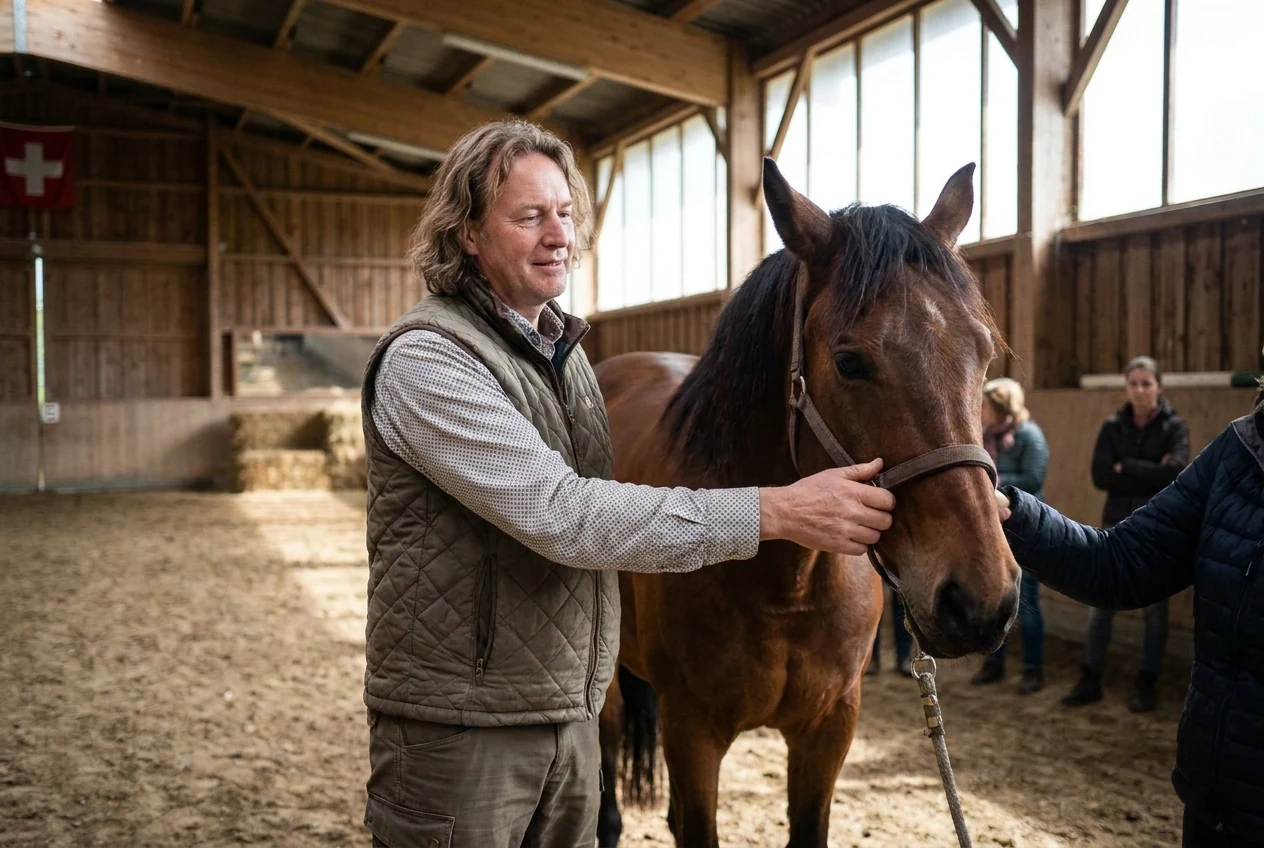
You stand in the stable and prepare the therapy horse while the first clients arrive. You lead balance exercises together. You watch closely as the participants' self-confidence grows step by step.

  • You assess the individual support needs of your clients through careful observation and conversation.
  • You plan and document therapy schedules. You continuously adapt them to the progress made.
  • You lead balance exercises and gymnastic elements to train motor coordination.
  • You accompany your clients during feeding and care. This strengthens the bond with the horse.
  • You use dexterity games and aids to specifically promote body awareness and perception.
  • You design individual and group sessions. They address emotional and social skills holistically.

Working conditions

You work mainly in your own riding stables or private businesses. Occasionally, you also work in care homes and clinics. Therapy often takes place in the stable or outdoors.

Strengths

  • Observational precision
  • Empathetic attitude
  • Horse expertise
  • Planning skills

Trade-offs

  • Independence
  • Part-time arrangement
  • Physical strain
  • Emotional responsibility

06 · Similar

You might also explore

All in Education & Social Work