Transport, Logistics & Safety

Fluginstruktor/in

You train future pilots in theory and practice for airplanes and helicopters.
Fluginstruktor/in

01 · Overview

What this profession is about

As Fluginstruktor/in, you train future pilots at flying schools or in the army. You guide their theoretical and practical flight training.

The sky is your workplace, but your real job starts on the ground. As Fluginstruktor/in, you pass on the necessary know-how to future pilots for safe flights. You plan training hours, correct flight maneuvers, and ensure the highest safety standards. Whether at civilian flying schools or in the army, your daily routine combines technical understanding with teaching skills.

FieldTransport, Logistics & Safety
Education pathSpecialisation / Professional Function
IndustryAviation
Swissdoc 0.634.4.0

02 · Salary

What you can earn

No verified Swiss salary data is available for this profession yet.
Salaries reflect Swiss market data. Range covers entry to senior. Salary reference based on Fluginstruktor/in.

03 · Pathway

How to enter and grow

Swiss training pathway available in the full profile

  • 🎓 Fluglehrer/in

Official education path

Training takes place at approved flying schools. It combines theoretical lessons with practical flight practice.

Typical training path

Fluglehrer/in

Prerequisites

  • Physical and mental resilience
  • Good observation skills
  • Social competence
  • Quick reaction ability
  • Technical understanding

04 · Skills & fit

What it takes

Required skills

  • Physical stamina
  • Sharp perception
  • Teaching skill
  • Technical understanding

Personality fit

  • Swiss career path
  • Career transition
  • Professional growth

05 · Daily reality

What the work feels like

Typical day

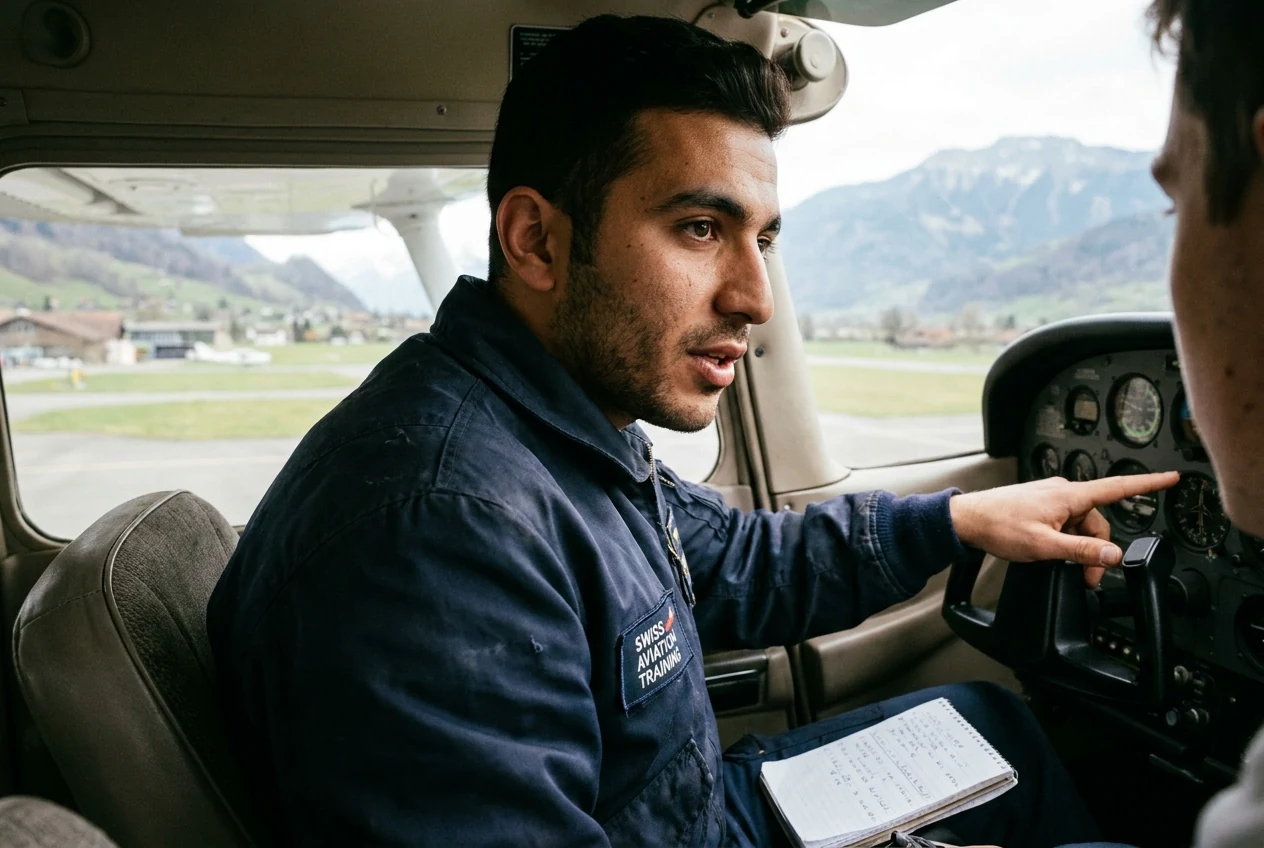
You stand next to the aircraft and discuss the next flight maneuvers with the student before you both board. In the cockpit, you give clear instructions and monitor the instruments to practice the right timing.

  • You plan and lead theoretical and practical training sessions for future pilots.
  • You train students in special flight maneuvers like night flying or instrument flying.
  • You monitor the flight execution and correct the student's technique in real time.
  • You update your own knowledge in meteorology, navigation, and aviation law.
  • You carry out administrative tasks around the flying school or airport.

Working conditions

You mainly work at commercial flying schools or military airfields. Your workplace includes hangars, training rooms, and the cockpit of airplanes or helicopters.

Strengths

  • Physical stamina
  • Sharp perception
  • Teaching skill
  • Technical understanding

Trade-offs

  • Weather dependency
  • High responsibility
  • Administrative burden
  • Shift work

06 · Similar

You might also explore

All in Transport, Logistics & Safety