Education & Social Work

Rehabilitationsexperte/-expertin für sehbehinderte und blinde Menschen HFP

You help people with visual impairments lead an independent life
Rehabilitationsexperte/-expertin für sehbehinderte und blinde Menschen HFP

01 · Overview

What this profession is about

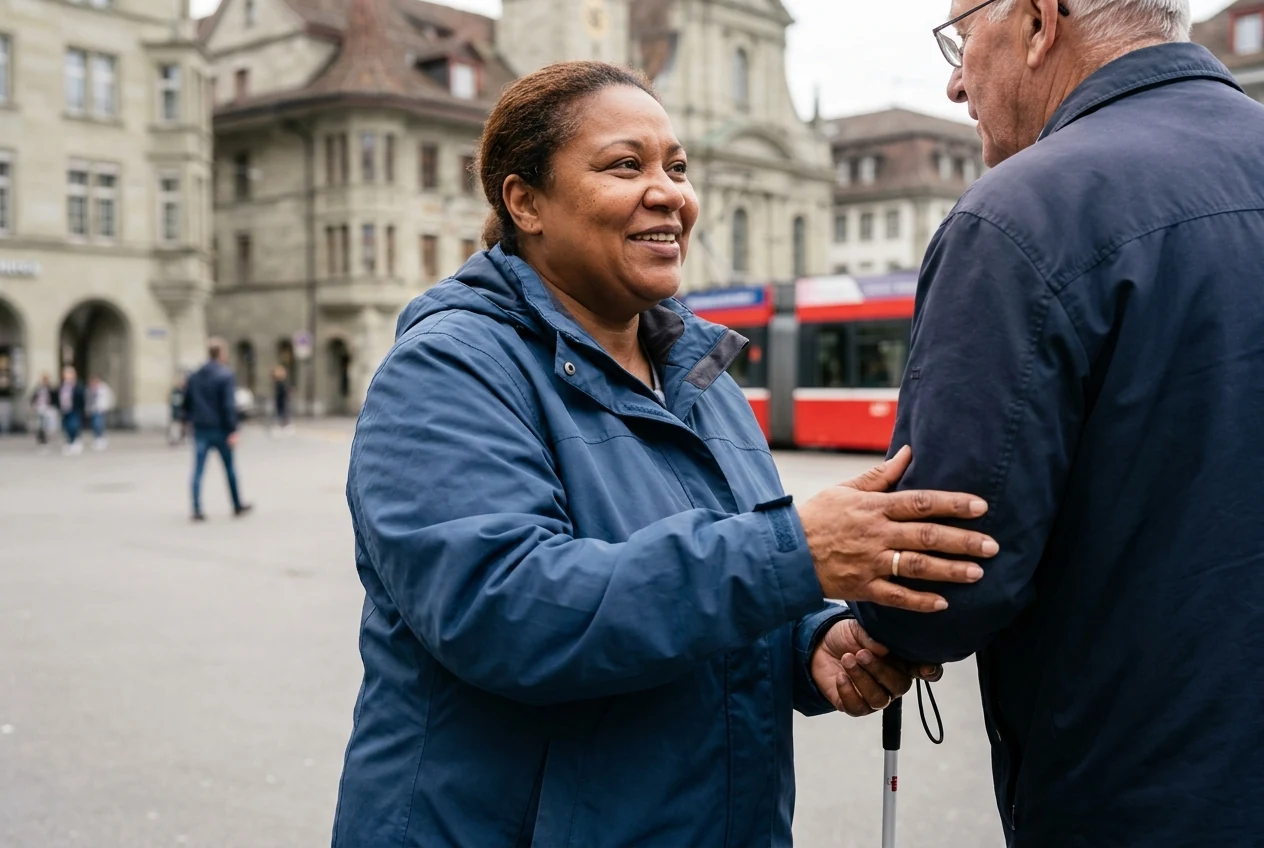
You advise and train people with visual impairments. You help them manage their daily routines and promote their independence.

Visual impairment or blindness changes daily life completely. As a rehabilitation expert, you accompany affected individuals on their path to greater independence. You develop individual training programs together. You introduce assistive devices and train spatial orientation. Your work combines professional knowledge with deep empathy. It opens the door to new hope for life.

FieldEducation & Social Work
Education pathContinuing Education Profession
IndustryConsulting
Swissdoc 0.731.43.0

02 · Salary

What you can earn

No verified Swiss salary data is available for this profession yet.
Salaries reflect Swiss market data. Range covers entry to senior. Salary reference based on Rehabilitationsexperte/-expertin für sehbehinderte und blinde Menschen HFP.

03 · Pathway

How to enter and grow

Swiss training pathway available in the full profile

  • 🎓 Rehabilitationsexperte/-expertin für sehbehinderte und blinde Menschen mit eidg. Diplom
  • ca. 1 Jahr, berufsbegleitend

Official education path

A part-time course lasting about one year. It prepares you for the federal exam.

Typical training path

Rehabilitationsexperte/-expertin für sehbehinderte und blinde Menschen mit eidg. Diplom

Prerequisites

  • eidg. Fähigkeitszeugnis in the fields of health, education, or social work and at least 5 years of professional practice in these areas with a minimum workload of 60%
  • Tertiary level degree (e.g. eidg. Berufsprüfung, höhere Fachprüfung, höhere Fachschule, Fachhochschule, or university) in the fields of health, education, or social work and at least 2 years of professional practice in these areas with a minimum workload of 60%
  • Required module completions
  • Proof of required internships and hospitations

Requirements

  • Sociability and communication skills
  • Empathy
  • Patience and endurance

04 · Skills & fit

What it takes

Required skills

  • Empathy and friendliness
  • Patience and endurance
  • Professional knowledge and advice
  • Organizational skills

Personality fit

  • Swiss career path
  • Career transition
  • Professional growth

05 · Daily reality

What the work feels like

Typical day

You meet a new client. You discuss the right visual aids for daily life together. Then you practice step by step. You show how to use the devices safely at home.

  • You analyze individual needs together with your clients. You plan suitable support measures.
  • You conduct targeted training sessions. You help improve remaining visual perception.
  • You select suitable visual aids and non-optical devices. You demonstrate how to use them.
  • You train affected individuals in practical life skills. You cover cooking, housekeeping, and personal care.
  • You teach techniques for safe orientation and mobility. You apply them to daily routines.
  • You work closely with doctors and therapists. You collaborate with educational specialists.

Working conditions

You are often on the move. You frequently conduct your consultations directly at the clients' homes. You also work for visual impairment organizations, nursing homes, or specialized schools.

Strengths

  • Empathy and friendliness
  • Patience and endurance
  • Professional knowledge and advice
  • Organizational skills

Trade-offs

  • Emotional strain
  • High travel activity
  • Complex case management
  • Administrative effort

06 · Similar

You might also explore

All in Education & Social Work