Culture & Media

Dramaturg/in

You curate texts and accompany cultural productions from the first idea to the stage.
Dramaturg/in

01 · Overview

What this profession is about

Dramaturginnen and Dramaturgen plan cultural programmes, curate texts, and accompany productions in theatre or media.

At the heart of the cultural landscape, you design programmes that move people. As a Dramaturg/in, you connect literature, society, and art. You curate works, advise teams, and accompany productions from the first idea to the premiere. Your analytical eye and your strong communication skills make the difference.

FieldCulture & Media
Education pathHigher Education Profession
IndustryStage
Swissdoc 0.825.19.0

02 · Salary

What you can earn

No verified Swiss salary data is available for this profession yet.
Salaries reflect Swiss market data. Range covers entry to senior. Salary reference based on Dramaturg/in.

03 · Pathway

How to enter and grow

Swiss training pathway available in the full profile

  • 🎓 Bachelor of Arts ZFH in Theater, Praxisfeld Dramaturgie (ZHDK) oder Master of Arts en lettres et sciences humaines (UNINE)
  • 3 Jahre Bachelor, Vollzeit 2 Jahre Master, Vollzeit

Official education path

A degree at a university of applied sciences or a university provides the necessary theoretical and practical training for dramaturgy.

Typical training path

Bachelor of Arts ZFH in Theater, Praxisfeld Dramaturgie (ZHDK) oder Master of Arts en lettres et sciences humaines (UNINE)

Prerequisites

  • Fachhochschule: gymnasiale Maturität, Berufsmaturität or Fachmaturität (Musik/Theater)
  • Passed aptitude test (for Fachhochschule)
  • Universität: gymnasiale Maturität
  • Universität: Berufsmaturität with passed Passerelle
  • Universität: Bachelor's degree (FH, PH, UH, ETH)

Requirements

  • Strong interest in literature, culture, and socio-political issues
  • Analytical-conceptual skills
  • Oral and written expression skills
  • Ability to develop, implement, and review projects
  • Resourcefulness and creativity
  • Flair for communication issues

Where this can lead

Career changes are possible if you have already worked as an assistant in a cultural institution. Working as a freelancer or in an independent theatre group also opens up new perspectives.

04 · Skills & fit

What it takes

Required skills

  • Analytical strength
  • Communication skills
  • Conceptual thinking
  • Network and contacts

Personality fit

  • Swiss career path
  • Career transition
  • Professional growth

05 · Daily reality

What the work feels like

Typical day

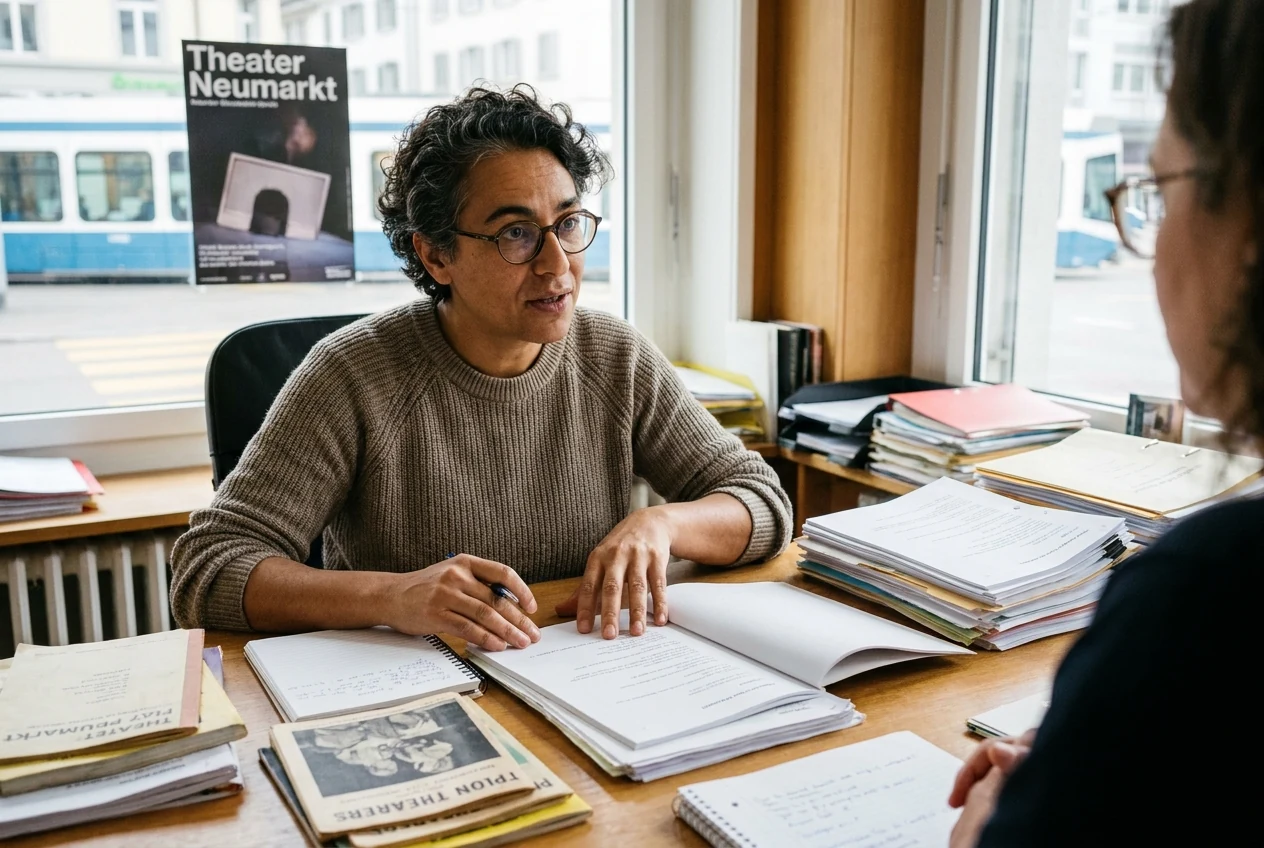
You sit at the long table with the directors. You discuss the next text passages for the coming season. You carefully check if the historical references are correct. You also think about how to make the story accessible to today's audience.

  • You read and evaluate literary texts for the coming season.
  • You curate works and plan them into the overall programme.
  • You commission writers and adapt texts for productions.
  • You negotiate with publishers and sign legally secure contracts.
  • You advise directors on casting and steer the production.
  • You analyze social debates and integrate them into the art.
  • You write texts for funding applications and programme booklets.
  • You organize cultural outreach programmes and accompany the audience at events.

Working conditions

You work in theatre and opera houses, at radio and television stations, and on festivals. You often switch between office work, rehearsal rooms, and event venues.

Strengths

  • Analytical strength
  • Communication skills
  • Conceptual thinking
  • Network and contacts

Trade-offs

  • Irregular hours
  • High competition
  • Financial uncertainty
  • Creative friction

06 · Similar

You might also explore

All in Culture & Media